
Start with a specific business question
An AI-ready data foundation starts with a question the business wants to answer. Identify the fields that matter, where they originate, and who can explain their meaning. Customer names, product identifiers, and transaction dates often need shared definitions before more advanced analysis becomes useful. Avoid moving every dataset simply because it is available.
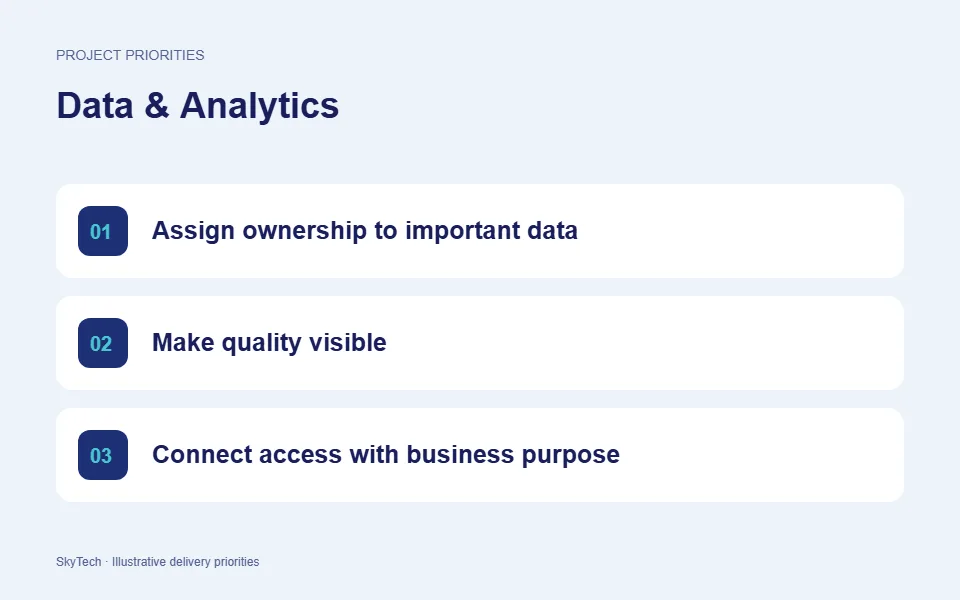
A practical next step: Assign ownership to important data. Write down the current approach, agree on an owner, and define one outcome the team can review. Keep the first change focused enough that users can explain what improved and what still needs attention.
SkyTech Insight“A useful data & analytics foundation is one your teams can understand, use consistently, and improve as the business changes.”
Make data quality part of the workflow
Define practical checks for missing values, duplicates, unexpected changes, and stale records. Show the results to the teams that create and use the information. Give each quality issue an owner and a correction path. A dashboard is helpful when it directs action; it is less useful when it reports a score that no team is responsible for improving.
A practical next step: Make quality visible. Write down the current approach, agree on an owner, and define one outcome the team can review. Keep the first change focused enough that users can explain what improved and what still needs attention.

Keep access and accountability together
Document who can access a dataset, why they need it, and how long the permission should last. Keep the history of important changes and explain the limitations of the data alongside the analysis. Start an AI pilot with a narrow, well-understood dataset and review its outputs with the people who know the underlying operation.
A practical next step: Connect access with business purpose. Write down the current approach, agree on an owner, and define one outcome the team can review. Keep the first change focused enough that users can explain what improved and what still needs attention.
A short, silent overview of the key ideas. Use the player controls to replay or show captions.